AFT Calculator
Enter your graded results for a planning estimate. Your entries stay in this browser.
Approved May 15, 2025 · Effective June 1, 2025 · Policy reviewed September 30, 2026 (UTC+5).
Combat specialties: Army Directive 2026-07, Enclosure 2. Army AFT Guidance.
This estimate is not an official record. Modified tests require authorized profile rules. CFT results, promotion points and body-composition assessments are separate.
By ArmyCalc Editorial · Policy last verified: October 11, 2026 · Report an error
Use this AFT calculator to convert your recorded performance into event points and check your total Army Fitness Test score. Enter your deadlift weight, hand-release push-up repetitions, sprint-drag-carry time, plank time, and two-mile run time using the appropriate scoring category.
For a complete five-event test, you must earn at least 60 points in every event. The general standard requires a minimum total of 300 points, while the combat standard requires 350. A strong total cannot compensate for an event below its passing minimum.
The AFT replaced the Army Combat Fitness Test on June 1, 2025. Army Directive 2025-06 established the test and its passing requirements. Later directives update specific requirements, so use current guidance alongside the original policy.
An online calculation helps you review practice results and plan improvements. Your official record comes only from the test your unit administers and records.
How To Use The AFT Calculator
Start with the measurements accepted by your grader or recorded during a properly measured practice session.
- Select General or Combat scoring based on your applicable MOS or officer area of concentration.
- Choose your age on the date of the test.
- Select the applicable sex category when using the general standard.
- Enter the total deadlift weight successfully lifted for three repetitions.
- Enter your valid hand-release push-up repetitions.
- Enter your sprint-drag-carry, plank, and two-mile run times.
- Review each event score before checking the overall total.
Use minutes and seconds for timed inputs. For example, a two-mile run of 19:45 means 19 minutes and 45 seconds. Typing 19.45 is read as decimal minutes, which is about 19 minutes and 27 seconds, and can change the calculated result.
Check the weight unit before entering your deadlift. If the field asks for pounds, convert a measurement recorded in kilograms first.
Keep your original performance measurements with your results. They make it easier to investigate an unexpected score or compare practice sessions.
AFT General And Combat Standards
Your scoring category determines the performance thresholds used to calculate your points.
The general standard uses age- and sex-based scoring. The combat standard uses age-based, sex-neutral scoring for designated combat specialties.
Both require every event to pass. Under the combat standard, reaching all five event minimums produces 300 points, leaving another 50 points to earn across the test.
The combat standard took effect on January 1, 2026 for the Regular Army, Active Guard Reserve, and Reserve Component Soldiers on active-duty orders of more than 60 days. It took effect on June 1, 2026 for other Reserve Component Soldiers. See the Army AFT page for the implementation timeline.
A personal goal such as 400 or 450 points can help guide training, but it does not replace the applicable passing requirements. Check the published requirements in Army Directive 2025-06.
Which Specialties Use The Combat Standard?
The designated list includes 24 MOSs and officer areas of concentration:
- Infantry: 11A, 11B, 11C, and 11Z
- Engineers and divers: 12A, 12B, and 12D
- Field artillery: 13A and 13F
- Special Forces: 18A, 180A, 18B, 18C, 18D, 18E, 18F, and 18Z
- Armor and cavalry: 19A, 19C, 19D, 19K, and 19Z
- Explosive ordnance disposal: 89D and 89E
Army Directive 2026-07 added 12D, 89D, and 89E to the earlier list of 21 specialties. Some older AFT summaries still show the original list. Use the updated Army physical fitness standards directive when checking your category.
Confirm your exact MOS or AOC with your unit rather than selecting Combat simply because you work in a combat unit. The same 24 specialties are the ones required to take the Army Combat Field Test.
How Age And Scoring Columns Affect Your Result
Select the age bracket that includes your age on test day. When comparing assessments from different dates, check whether you moved into another bracket between tests.
In the published scoring tables, M / C identifies the male general and combat scoring column. F identifies the female general column. Combat scoring uses the M / C column regardless of sex.
A calculator comparison is meaningful only when the age bracket and scoring category match. Identical performance can produce different points in different columns.
Use the official AFT scoring tables to verify these selections.
The Five AFT Events In Order
The test follows this sequence:
- Three-Repetition Maximum Deadlift
- Hand Release Push-Up, Arm Extension
- Sprint-Drag-Carry
- Plank
- Two-Mile Run
For movement demonstrations and administration details, consult the official Army AFT event guidance. The explanations below focus on recording useful calculator inputs.
Three-Repetition Maximum Deadlift
Enter the total weight successfully lifted for three valid repetitions, including the bar and plates.
A single successful repetition at a heavier weight is not the same measurement. Record the accepted three-repetition result rather than your gym one-repetition maximum.
For training comparisons, note the equipment used. Consistent equipment and accepted technique make your recorded results easier to compare.
Hand Release Push-Up
Enter the number of valid repetitions completed during the two-minute event. Each repetition includes the prescribed arm extension.
Use the grader’s accepted count. Counting attempted repetitions can overstate performance when some repetitions do not meet the movement standard.
If your practice count varies considerably between sessions, review technique and counting consistency before assuming that the difference reflects improved endurance.
Sprint-Drag-Carry
Enter the elapsed time for the complete 250-meter sequence: sprint, drag, lateral movement, carry, and final sprint.
The official setup uses a 25-meter lane, a 90-pound sled, and two 40-pound kettlebells. Equipment and surface differences can affect practice comparisons.
Record the complete sequence rather than one shuttle or the final sprint alone. When reviewing training, note where time was lost during turns or changes between movements.
Plank
Enter the duration maintained in the required position. The grader determines when the event ends.
A practice hold that continues after the accepted position is lost does not provide a comparable calculator input. Use a consistent start and stop method when tracking improvement.
Record the result in minutes and seconds rather than entering only the seconds portion of the time.
Two-Mile Run
Enter the finish time for a measured two-mile course.
A treadmill estimate, GPS reading, or shorter practice route may help with training, but label it accurately in your log. Course differences can make two results look more comparable than they are.
Your AFT run follows the preceding events. Keep rested standalone runs separate from complete-test results when assessing progress.
The measurements and equipment summarized above come from the Army AFT event instructions.
How To Read The Official AFT Scoring Tables
Find the relevant event, age bracket, and scoring column. Match your recorded performance to the published threshold, then read the corresponding points.
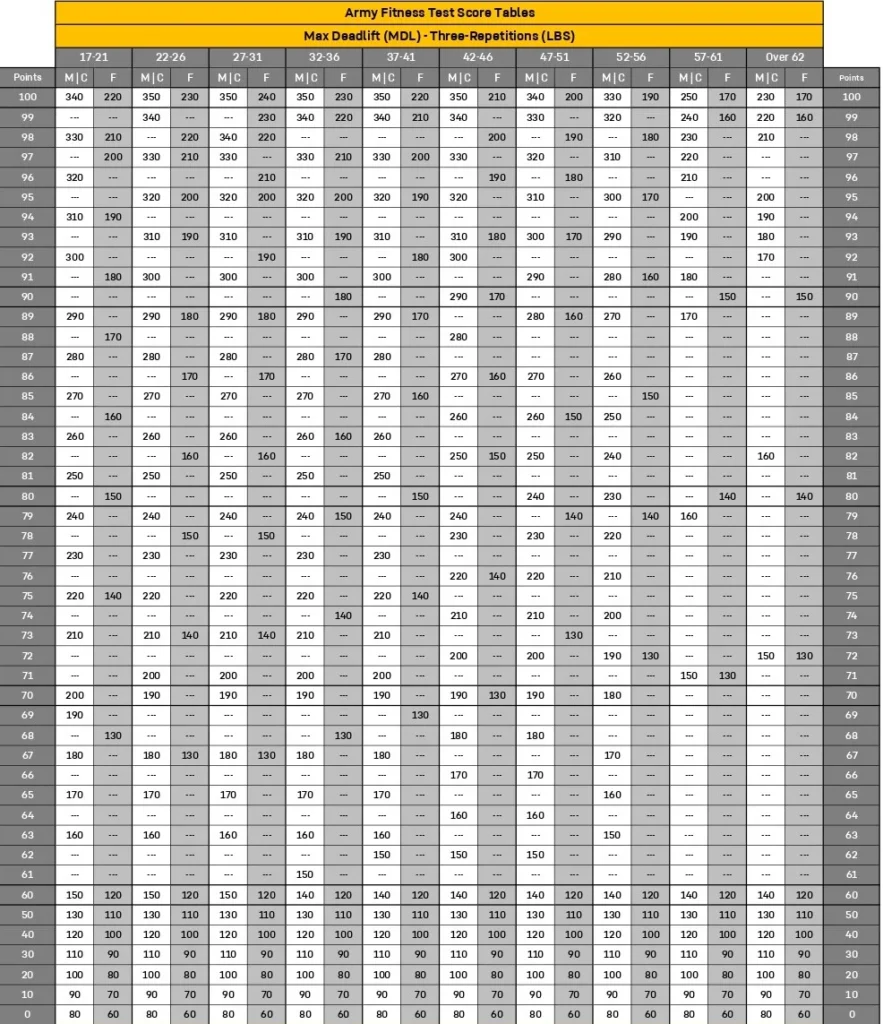
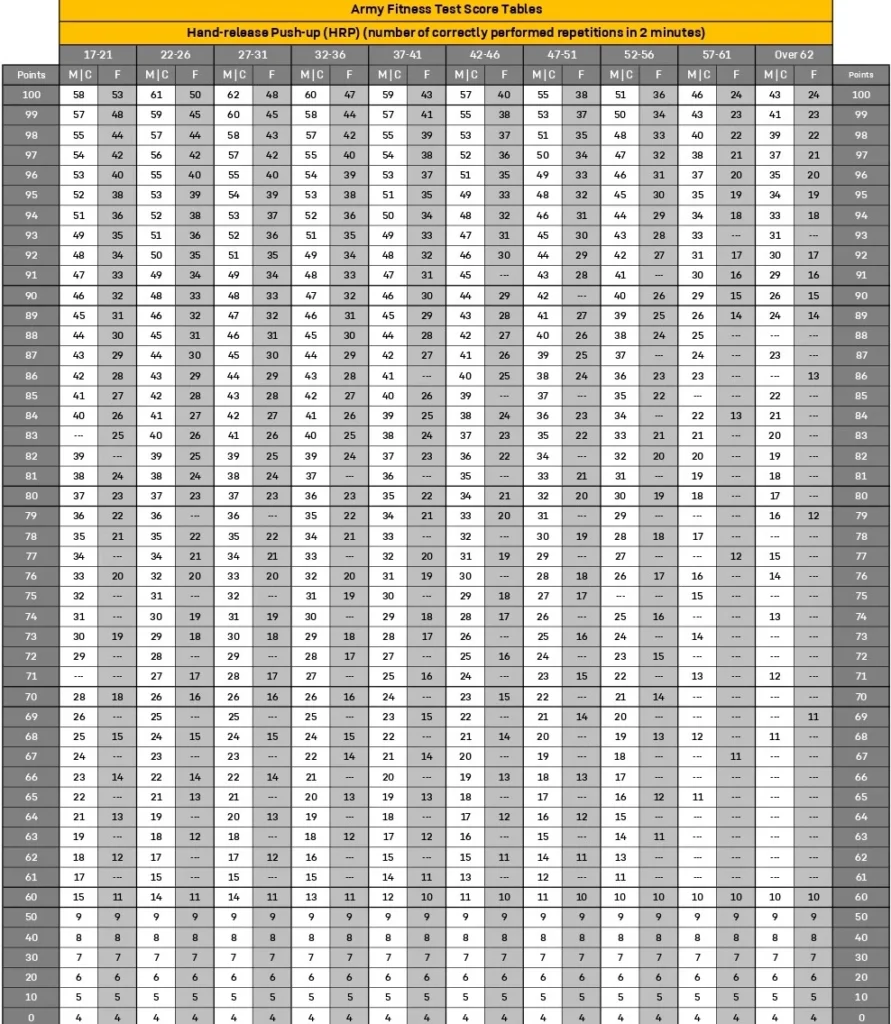
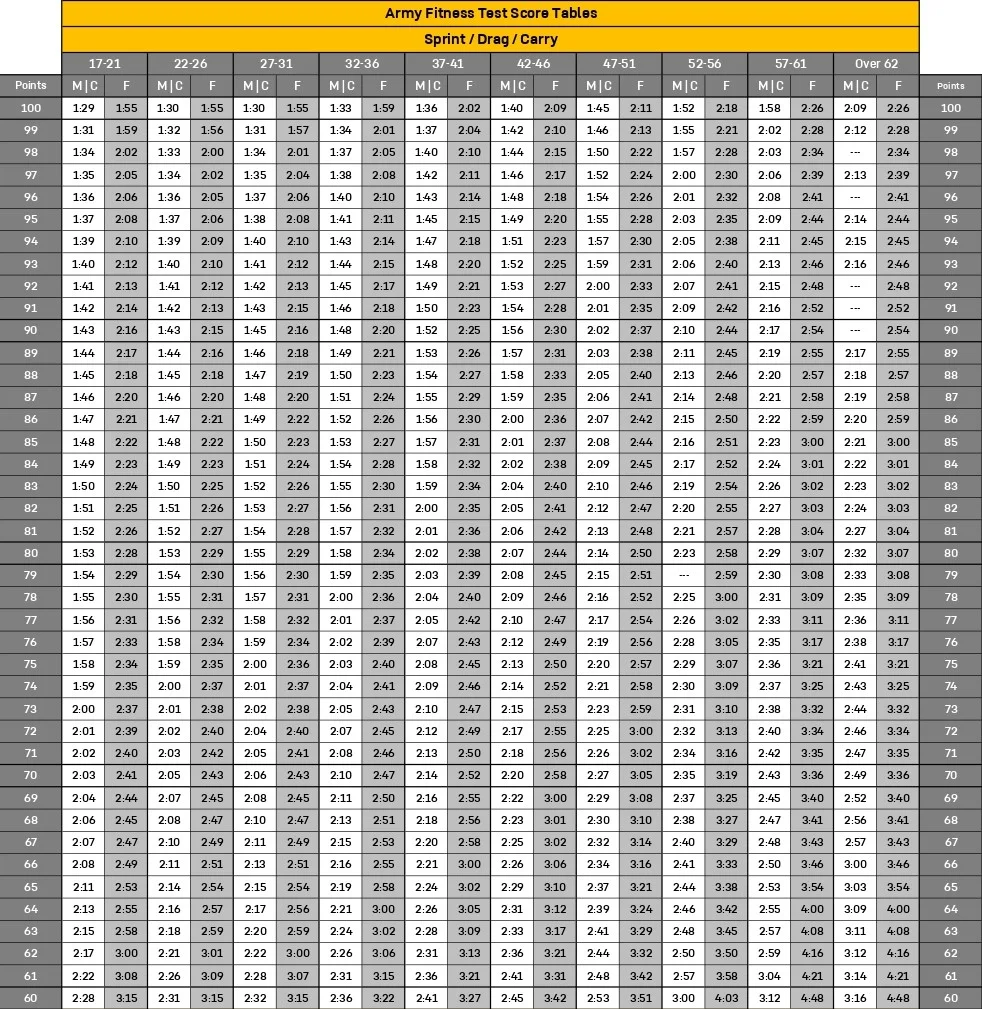
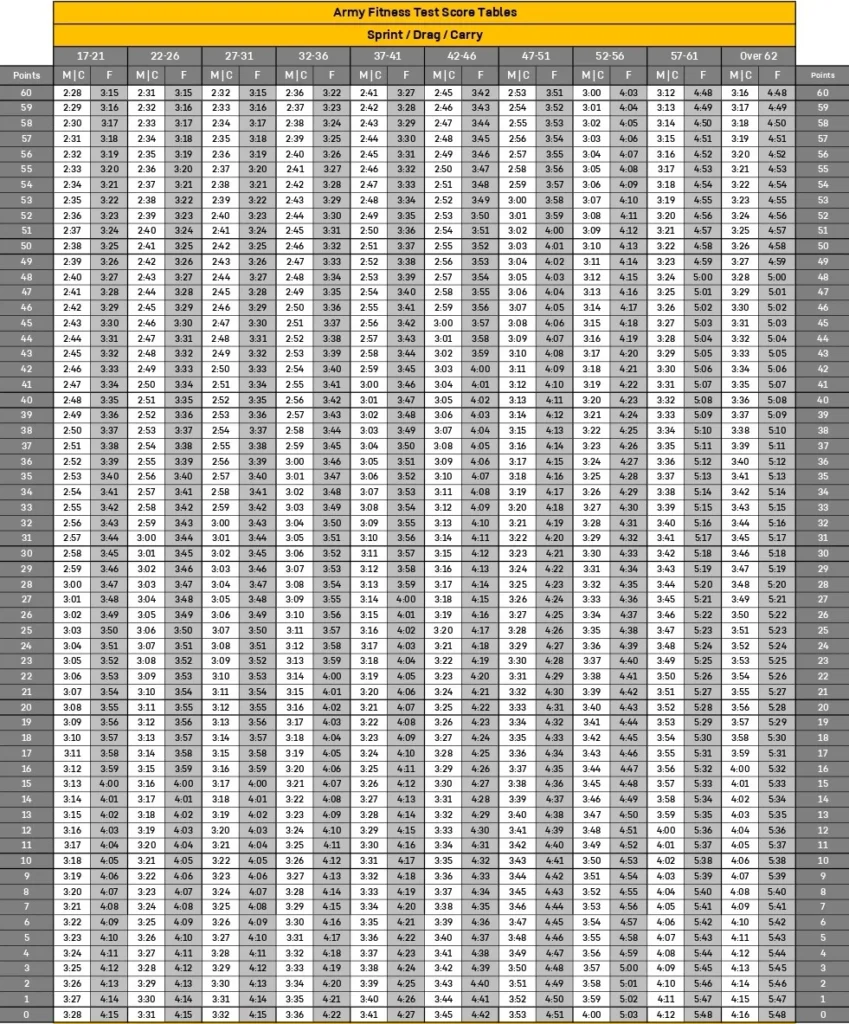
For ages 22–26, the published 60-point thresholds are:
| Event | General Male / Combat | General Female |
|---|---|---|
| Deadlift | 150 pounds | 120 pounds |
| Hand-release push-ups | 14 repetitions | 11 repetitions |
| Sprint-drag-carry | 2:31 or faster | 3:15 or faster |
| Plank | 1:25 or longer | 1:25 or longer |
| Two-mile run | 19:45 or faster | 22:45 or faster |
These examples apply to that age bracket, not every Soldier. The tables below cover every age bracket, and the official scoring tables list every point from 60 to 100.
The tables were approved on May 15, 2025, and became effective June 1, 2025. Scoring steps vary: an extra repetition, pound, or second does not always produce another point.
AFT Standards By Age: Men And Combat (M / C)
Each cell shows the 100-point maximum, then the 60-point minimum.
| Age | Deadlift (lb) | Hand-release push-ups | Sprint-drag-carry | Plank | Two-mile run |
|---|---|---|---|---|---|
| 17–21 | 340 / 150 | 58 / 15 | 1:29 / 2:28 | 3:40 / 1:30 | 13:22 / 19:57 |
| 22–26 | 350 / 150 | 61 / 14 | 1:30 / 2:31 | 3:35 / 1:25 | 13:25 / 19:45 |
| 27–31 | 350 / 150 | 62 / 14 | 1:30 / 2:32 | 3:30 / 1:20 | 13:25 / 19:45 |
| 32–36 | 350 / 140 | 60 / 13 | 1:33 / 2:36 | 3:25 / 1:15 | 13:42 / 20:44 |
| 37–41 | 350 / 140 | 59 / 12 | 1:36 / 2:41 | 3:20 / 1:10 | 13:42 / 20:44 |
| 42–46 | 350 / 140 | 57 / 11 | 1:40 / 2:45 | 3:20 / 1:10 | 14:05 / 22:04 |
| 47–51 | 340 / 140 | 55 / 11 | 1:45 / 2:53 | 3:20 / 1:10 | 14:30 / 22:04 |
| 52–56 | 330 / 140 | 51 / 10 | 1:52 / 3:00 | 3:20 / 1:10 | 15:09 / 22:50 |
| 57–61 | 250 / 140 | 46 / 10 | 1:58 / 3:12 | 3:20 / 1:10 | 15:28 / 23:36 |
| Over 62 | 230 / 140 | 43 / 10 | 2:09 / 3:16 | 3:20 / 1:10 | 15:28 / 23:36 |
AFT Standards By Age: Women (General Standard)
Each cell shows the 100-point maximum, then the 60-point minimum.
| Age | Deadlift (lb) | Hand-release push-ups | Sprint-drag-carry | Plank | Two-mile run |
|---|---|---|---|---|---|
| 17–21 | 220 / 120 | 53 / 11 | 1:55 / 3:15 | 3:40 / 1:30 | 16:00 / 22:55 |
| 22–26 | 230 / 120 | 50 / 11 | 1:55 / 3:15 | 3:35 / 1:25 | 15:30 / 22:45 |
| 27–31 | 240 / 120 | 48 / 11 | 1:55 / 3:15 | 3:30 / 1:20 | 15:30 / 22:45 |
| 32–36 | 230 / 120 | 47 / 11 | 1:59 / 3:22 | 3:25 / 1:15 | 15:48 / 22:50 |
| 37–41 | 220 / 120 | 43 / 10 | 2:02 / 3:27 | 3:20 / 1:10 | 15:51 / 22:59 |
| 42–46 | 210 / 120 | 40 / 10 | 2:09 / 3:42 | 3:20 / 1:10 | 16:00 / 23:15 |
| 47–51 | 200 / 120 | 38 / 10 | 2:11 / 3:51 | 3:20 / 1:10 | 16:30 / 23:30 |
| 52–56 | 190 / 120 | 36 / 10 | 2:18 / 4:03 | 3:20 / 1:10 | 16:59 / 24:00 |
| 57–61 | 170 / 120 | 24 / 10 | 2:26 / 4:48 | 3:20 / 1:10 | 17:18 / 24:48 |
| Over 62 | 170 / 120 | 24 / 10 | 2:26 / 4:48 | 3:20 / 1:10 | 17:18 / 25:00 |
The official scoring tables label the last column “Over 62”. A Soldier who is exactly 62 falls between the 57–61 and Over 62 labels, so confirm the correct column with your unit.
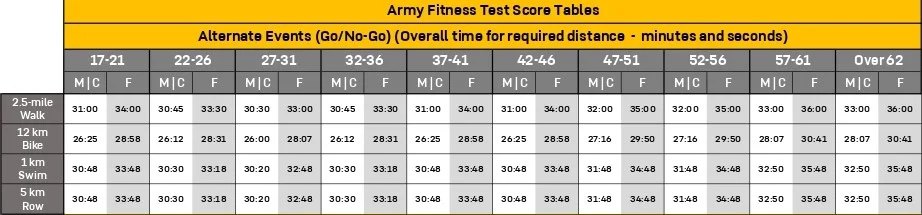
Alternate Aerobic Events (GO / NO-GO)
Soldiers with a permanent profile that prevents the two-mile run may take an authorized alternate aerobic event. These events are scored GO or NO-GO against a time limit, with no points. Each cell shows the time for men and combat, then women.
| Age | 2.5-mile walk | 12-km bike | 1-km swim | 5-km row |
|---|---|---|---|---|
| 17–21 | 31:00 / 34:00 | 26:25 / 28:58 | 30:48 / 33:48 | 30:48 / 33:48 |
| 22–26 | 30:45 / 33:30 | 26:12 / 28:31 | 30:30 / 33:18 | 30:30 / 33:18 |
| 27–31 | 30:30 / 33:00 | 26:00 / 28:07 | 30:20 / 32:48 | 30:20 / 32:48 |
| 32–36 | 30:45 / 33:30 | 26:12 / 28:31 | 30:30 / 33:18 | 30:30 / 33:18 |
| 37–41 | 31:00 / 34:00 | 26:25 / 28:58 | 30:48 / 33:48 | 30:48 / 33:48 |
| 42–46 | 31:00 / 34:00 | 26:25 / 28:58 | 30:48 / 33:48 | 30:48 / 33:48 |
| 47–51 | 32:00 / 35:00 | 27:16 / 29:50 | 31:48 / 34:48 | 31:48 / 34:48 |
| 52–56 | 32:00 / 35:00 | 27:16 / 29:50 | 31:48 / 34:48 | 31:48 / 34:48 |
| 57–61 | 33:00 / 36:00 | 28:07 / 30:41 | 32:50 / 35:48 | 32:50 / 35:48 |
| Over 62 | 33:00 / 36:00 | 28:07 / 30:41 | 32:50 / 35:48 | 32:50 / 35:48 |
How To Calculate Your Total AFT Score
Convert each performance measurement into its event points, then add the five scores:
Total AFT score = deadlift points + push-up points + sprint-drag-carry points + plank points + two-mile run points.
The maximum is 500 points. You cannot calculate a meaningful total by adding pounds, repetitions, and elapsed times together.
These hypothetical examples show how to interpret a result:
| Event points in test order | Total | Interpretation |
|---|---|---|
| 60 + 60 + 60 + 60 + 60 | 300 | Meets General; below Combat |
| 70 + 70 + 70 + 70 + 70 | 350 | Meets both full-test standards |
| 60 + 65 + 75 + 70 + 80 | 350 | Another distribution that meets Combat |
| 80 + 80 + 80 + 80 + 59 | 379 | Fails because one event is below 60 |
These are planning examples, not recommended event targets.
Review your lowest event first. If every event passes, calculate the remaining gap between your total and the applicable requirement.
Do Combat Soldiers Need 70 Points In Every Event?
For an unmodified five-event test, the combat requirement is an overall total of 350 with every event meeting its minimum.
Seventy points in each event is one possible distribution. The third example above shows another: some events earn fewer than 70 points while others earn more.
Do not confuse this full-test calculation with the separate average requirement that applies to certain permanent-profile cases.
Profiles And Alternate Events
A permanent profile can change which AFT events a Soldier is authorized to perform. The original directive requires completion of permitted events and a GO on an authorized alternate aerobic event when applicable.
For combat specialties, it also specifies a minimum average of 70 points across the events performed. This is a modified-test rule, not a requirement to earn 70 in every event of a complete test. Army Directive 2025-06 states the passing totals as follows: four events, 280 points; three events, 210 points; two events, 140 points; one event, 70 points.
Review Army Directive 2025-06 with your test administrator for the applicable calculation.
Published alternate aerobic assessments include the walk, bike, swim, and row. Their authorization and GO/NO-GO requirements should be checked in the official AFT scoring tables.
Do not enter zero for a prohibited event or invent a run time to force a five-event calculation. A calculator without profile support cannot establish the modified outcome.
Combat-specialty Soldiers with permanent profiles that prevent a primary AFT event also face separate CFT eligibility and reclassification provisions under Army Directive 2026-07.
AFT And CFT Testing Frequency
The 2026 directive changes the schedule for designated combat specialties:
- Regular Army, AGR, and Reserve Component Soldiers on active-duty orders of 365 days or more take one record AFT and one record CFT annually.
- Other Reserve Component combat-specialty Soldiers alternate the AFT and CFT by calendar year.
- The directive specifies four-month or eight-month intervals according to status, with an exception allowing certain additional AFTs for promotion or schooling.
These provisions should not be applied automatically to every Soldier. Profile waivers and the CFT transition period also affect scheduling. Check Army Directive 2026-07 and your unit’s instructions for your case.
The same directive requires evaluation reports to show both pass/fail status and the actual points earned on the record AFT.
AFT Vs. ACFT: What Changed?
The Army Fitness Test replaced the Army Combat Fitness Test on June 1, 2025. The AFT retains five events: deadlift, hand-release push-ups, sprint-drag-carry, plank, and the two-mile run. Removing the standing power throw reduced the maximum score from the ACFT’s 600 points to the AFT’s 500 points.
If you searched for an ACFT calculator to calculate a current Army fitness test, use this AFT calculator with the applicable AFT scoring category. For a historical six-event ACFT result, use the scoring tables that applied when that assessment was conducted.
Do not convert an old ACFT score by simply subtracting the standing power throw points. Calculate each retained event using the appropriate AFT scoring table, then check the event minimums and overall passing requirement.
See Army Directive 2025-06 for the transition and the official AFT scoring tables for current event calculations.
AFT Vs. CFT: Keep The Results Separate
AFT points and Combat Field Test time measure different assessments.
The CFT uses seven consecutive events and one cumulative passing limit of 30 minutes. It does not contribute points to the AFT’s 500-point total.
Use the CFT calculator to review that assessment’s elapsed time. Return to this AFT calculator for the five-event points calculation.
The CFT implementation order allows testing for record beginning April 17, 2027. Its transition schedule should not be confused with the AFT’s earlier implementation. See HQDA EXORD 103-26.
AFT Scores And Body Composition Requirements
A high AFT score does not exempt a Soldier from the current waist-to-height ratio requirement.
Under Army Directive 2026-13, issued in July 2026, the Army’s body-composition standard is a waist-to-height ratio below 0.55. A ratio of exactly 0.55 does not meet the standard. The directive states that no AFT score exempts a Soldier from the standard and rescinds Army Directive 2025-17, the earlier AFT-score body fat standard. Earlier references to an AFT high-score exemption should not be used to establish current compliance.
Fitness scoring and body-composition screening remain separate checks. For measurement procedures and implementation details, see the Army’s Body Composition Program and Standards FAQ. The FAQ refers to this directive by a different number (2026-06); the signed directive is titled 2026-13.
How To Use Your AFT Score For Training
Use the calculator to identify a specific, measurable next step.
First, record a baseline with your raw measurements and calculated points. Keep complete-test results separate from isolated event practice.
Next, address any event below its minimum. Increasing another event will not resolve that failed event.
Once all events pass, review your total-point gap. For example, a hypothetical combat score of 335 leaves 15 points to earn. Compare achievable changes across several events rather than assuming all 15 must come from your lowest score.
Change one input at a time to test a training target. Then record both the proposed performance and the points it would earn. This keeps a target such as “improve the run” tied to a measurable result.
Consider these questions when reviewing your log:
- Are repetitions being counted consistently?
- Did the course, surface, or equipment change?
- Is a low score caused by performance or incorrect input?
- Does an isolated improvement remain achievable during the full test?
- Is the target realistic within your current training schedule?
Calculator scenarios are planning estimates. Review your priorities with your unit’s fitness staff and follow applicable profile restrictions.
Common AFT Calculation Mistakes
Selecting The Wrong Standard
General and Combat scoring use different columns, and Combat uses the male / combat column for every Soldier. Check your applicable specialty before interpreting the result.
Using The Wrong Age Bracket
Use your age on test day. A saved age selection can give a different result once you move into the next bracket, for example from 26 to 27.
Entering Decimal Minutes
Enter 2:31 for a sprint-drag-carry of 2 minutes and 31 seconds. Typing 2.31 means 2.31 minutes, which is about 2 minutes and 19 seconds.
Mixing Pounds And Kilograms
Confirm the requested weight unit and include the hex bar and plates when recording the total deadlift load.
Counting Attempted Repetitions
Enter the grader’s accepted count. A calculator cannot recognize invalid movement from the number alone.
Entering One SDC Segment
The sprint-drag-carry input should represent the whole 250-meter sequence, not a single shuttle.
Looking Only At The Total
A total of 379 can still fail if one event is below 60. Review all five event scores.
Using An Old ACFT Table
A historical ACFT calculation is not interchangeable with current AFT scoring.
Treating A Profile As A Zero
A prohibited event requires the appropriate modified-test process rather than an ordinary five-event zero.
Combining AFT And CFT Results
Keep the AFT points total and CFT elapsed time separate in your records.
2026 AFT Scoring Chart
The following are the official AFT scoring charts for each test event. PDF versions of the grading scales are also available.
MDL Scoring Chart
HRP Scoring Chart
SDC Scoring Chart
PLK Scoring Chart
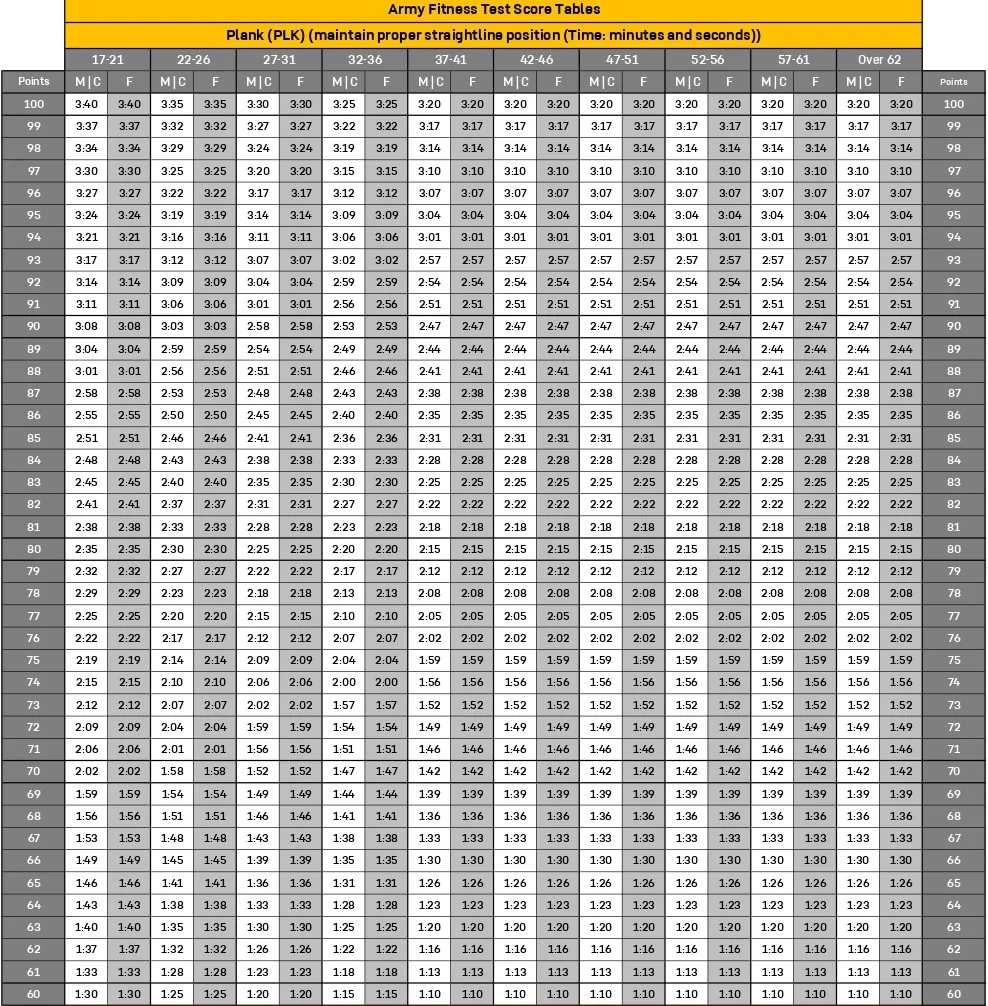
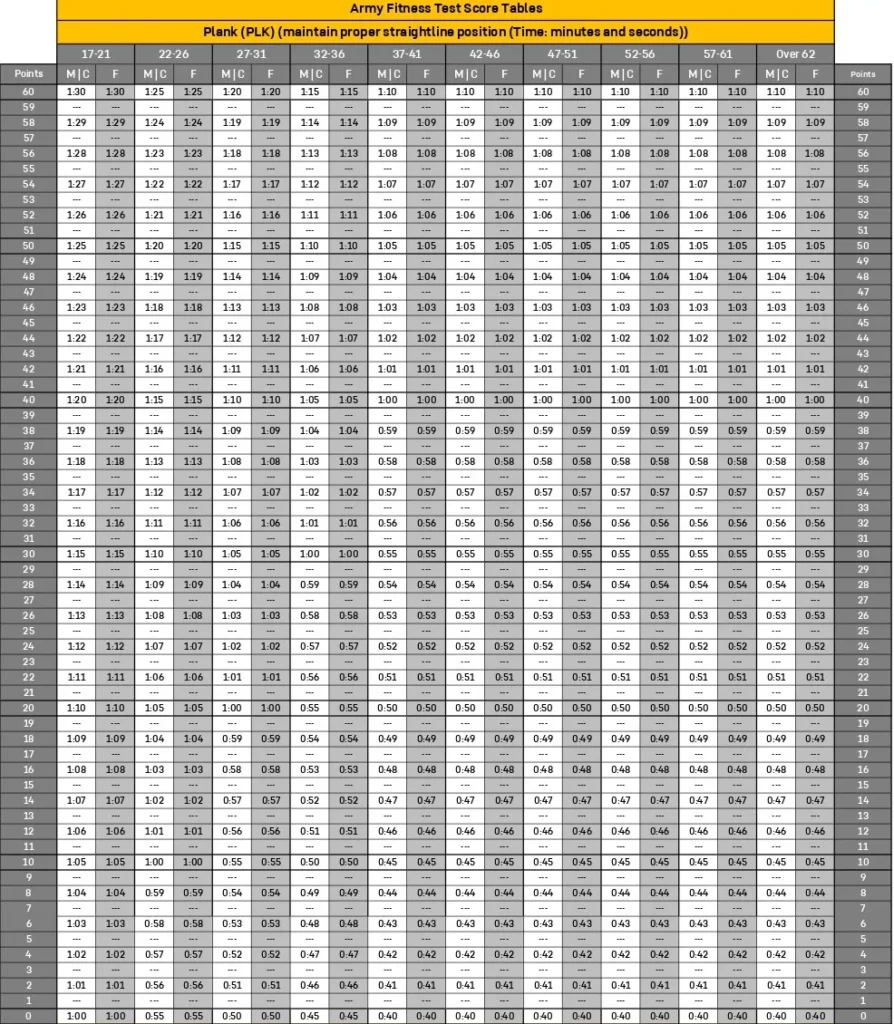
2MR Scoring Chart
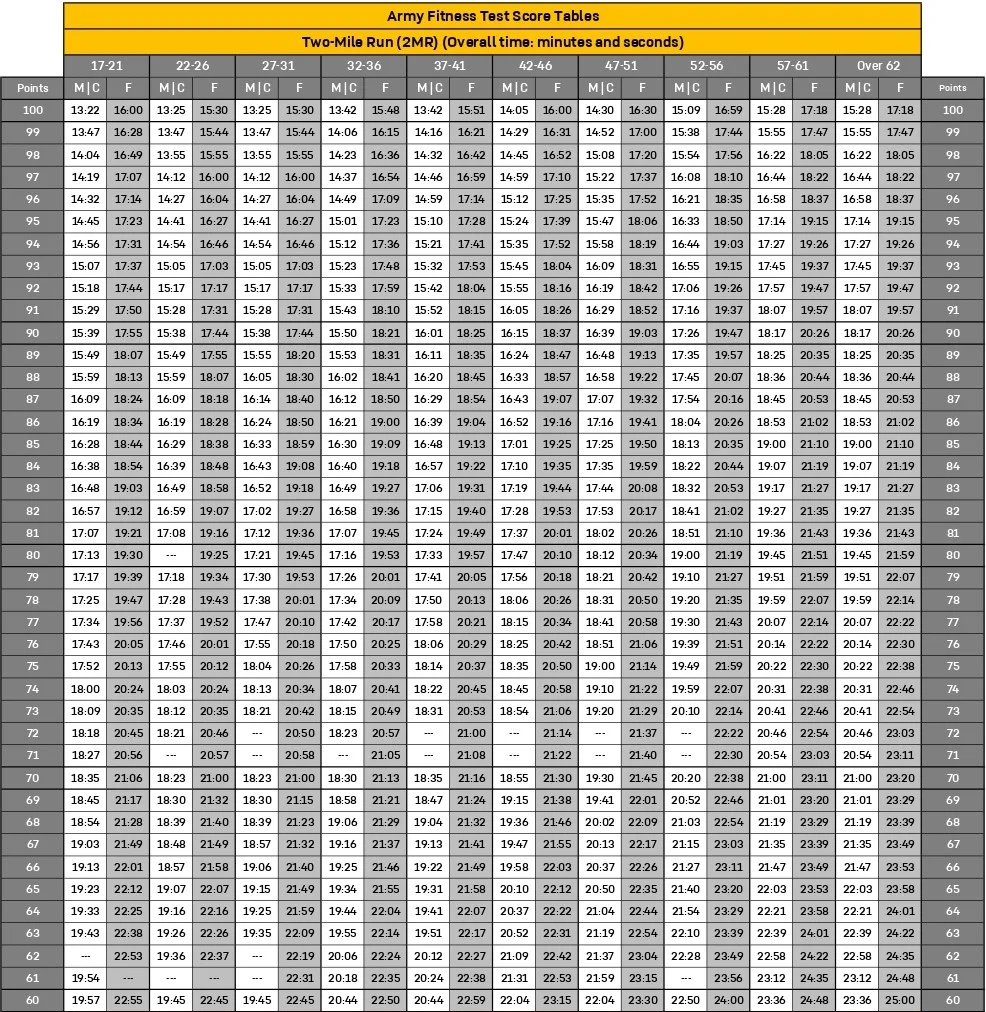
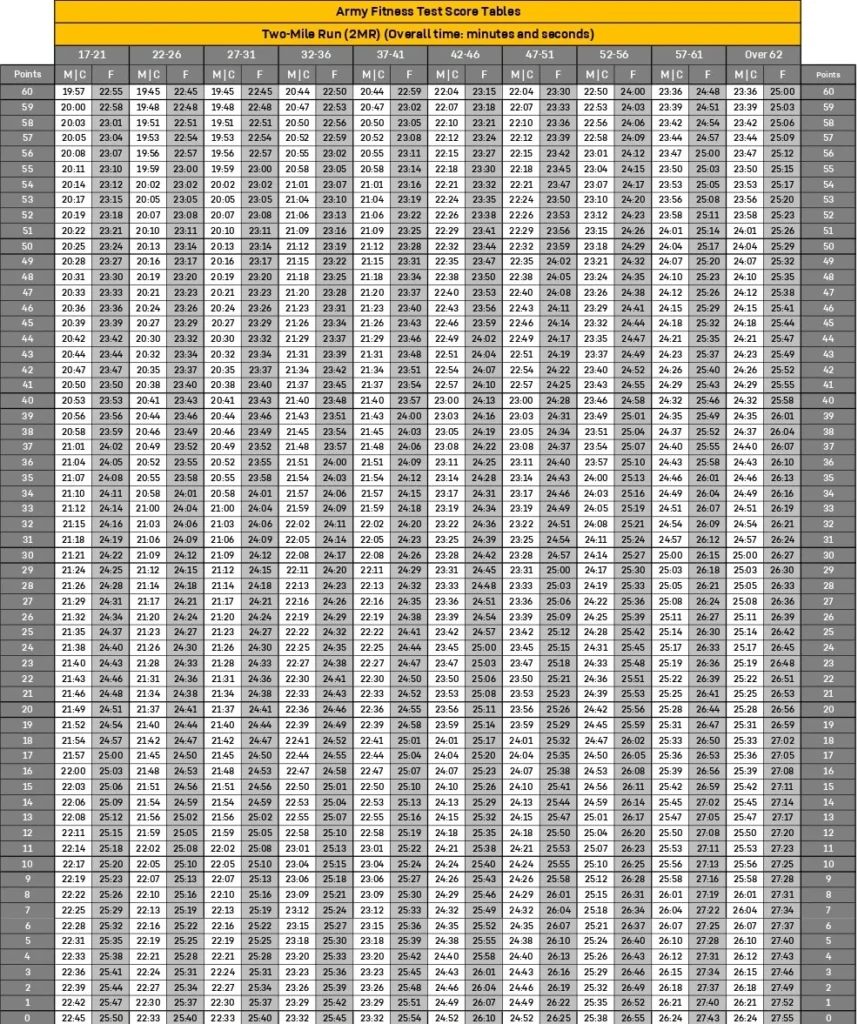
Alternate Events (GO/NO-GO)
Frequently Asked Questions
AFT stands for Army Fitness Test. It is the Army’s five-event fitness assessment.
For a complete test, the general requirement is 300 points and the combat requirement is 350, with every event meeting its minimum.
No. The event requirement and total requirement must both be met. The worked examples above show why reviewing only the total can be misleading.
The maximum is 500 points, earned by reaching 100 points in each of the five events.
No. Combat scoring is sex-neutral but remains age-based. Check the correct age bracket when selecting its scoring column.
No. For a full test, different event-score distributions can reach the required total. Permanent-profile average rules are a separate case.
Only if the calculator explicitly supports your authorized modified assessment. Otherwise, use it for permitted-event planning and confirm the official calculation with your administrator.
Compare the age bracket, scoring category, raw inputs, and scoring-table version. Review each event against the official table to locate the difference.
No. It is a separate requirement for designated combat specialties. Its time does not become AFT points.
No. The Army replaced its older physical fitness test with the ACFT and then the AFT, so an Army score uses the AFT tables. The Marine Corps still uses a PFT: use the USMC PFT calculator for that test, and keep its results out of an AFT calculation.
The current Army policy states that an AFT score does not exempt a Soldier from the waist-to-height ratio standard. Follow the body-composition guidance linked above.
No. A calculator cannot verify accepted technique, medical authorization, test administration, or entry into Army record systems.
Related Calculators
- Army CFT calculator — add your seven Combat Field Test splits and compare the total with the 30:00 standard for designated combat specialties.
- USMC PFT calculator — the Marine Corps fitness test, scored from pull-ups or push-ups, plank and the 3-mile run.
Official AFT Sources
Use these official Army references to verify event scoring, passing requirements, and applicable policy:
- Official Army Fitness Test Guidance — AFT overview, event instructions, and Army FAQs.
- Official AFT Scoring Tables — performance thresholds and event points for the published age and scoring categories.
- Army Directive 2025-06: Army Fitness Test — original AFT policy; read alongside subsequent amendments.
- Army Directive 2026-07: Army Physical Fitness Standards — updated combat-specialty requirements, testing schedules, and related profile provisions.
- Army Directive 2026-13: Army Body Composition Program and Standards — the separate waist-to-height ratio requirement.
How We Verify This Page
- Sources checked: Army Directive 2025-06, Army Directive 2026-07, Army Directive 2026-13, the official AFT scoring tables (approved May 15, 2025, effective June 1, 2025), and the Army AFT page.
- Last verified: October 11, 2026
- Method: Results were compared with the official scoring tables before publishing.
- Author: ArmyCalc Editorial
- Report an error: armycalc.net/contact-us or contact@armycalc.net
ArmyCalc is an independent website. It is not affiliated with, endorsed by, or sponsored by the U.S. Army. See our Terms & Conditions and Privacy Policy.